
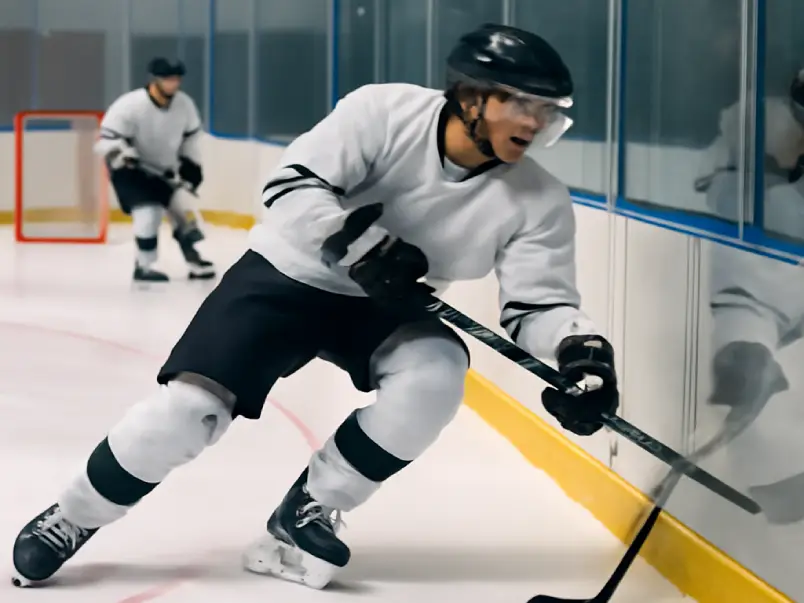
Imagine this: You’re deep in your defensive zone, with an opposing player closing in for a hit. You’re under pressure, but instead of scrambling blindly, you calmly rim the puck around the boards. It ricochets off the glass and lands right on your teammate’s stick at the blue line. A clean breakout is underway, and you’re off to the races.
This simple play is often overlooked, but it’s a powerful tactic that can shift the momentum of a game. The glass and boards in your rink aren’t just barriers or boundaries—they’re tools. The key to using them lies in mastering wall play, which turns this seemingly passive feature of the rink into a dynamic, strategic asset.
In this guide, we’ll explore how wall play can enhance both offensive and defensive strategies, giving you an edge on the ice. Whether you’re executing bank passes, clearing under pressure, or beating the trap, understanding and controlling the glass is the path to becoming a more tactically astute player.
Part 1: The Fundamentals – Understanding Your Tool
1.1 The Science of the Angle: It’s Not Magic, It’s Physics
When you use the glass for passes or clears, it’s crucial to understand the basic principle of angles. A shot off the glass behaves predictably, following the law of reflection: the angle at which the puck hits the glass is equal to the angle at which it bounces off.
It’s not magic—it’s physics. With enough practice, you can anticipate where the puck will go, even in the most chaotic situations. This predictability is what makes wall plays so valuable, especially in high-pressure moments.
1.2 “Reading” the Glass and Boards
The glass and boards are not uniform across every rink. The texture, tension, and stanchions that hold the boards in place can all impact the bounce of the puck. Some arenas have tighter glass, making for sharper bounces, while others may feature looser boards that offer more deflection.
To become proficient with wall play, you’ll need to learn the nuances of the rink where you’re playing. Warm-ups are the perfect time to gauge how the puck reacts, so take advantage of these moments to observe how the glass behaves. Knowing your rink’s quirks will help you make more precise plays when the game is on the line.
1.3 The Two Types of Wall Plays
There are two main types of wall plays:
- Bank Passes: These are passes off the glass that help you move the puck to a teammate.
- Clears/Dumps: These are used to relieve pressure, put the puck deep in the opponent’s zone, or clear it safely out of your defensive zone.
Both plays leverage the glass as an extension of your stick, helping you create opportunities or escape tough situations.
Part 2: Offensive Weaponry – Creating Chances from the Wall
2.1 The Art of the Bank Pass: Springing the Breakout
A perfect example of offensive wall play is the bank pass. Breaking out of your zone under pressure can be a daunting task, especially with aggressive forechecking. But with a well-timed bank pass, you can turn the tables.
Imagine you’re behind your net, and a defender is charging toward you. You bank the puck off the glass, and it bounces neatly to a winger waiting at the hash marks. The play allows your teammate to control the puck and carry it out of the zone without a hit or turnover.
Key Tip: Communication is key. Make sure to signal your teammate before you make the pass, so they’re prepared to receive it cleanly.
2.2 The High Flip off the Glass: Beating the Trap
When facing a neutral zone trap, it can feel like you’re boxed in on all sides. But by using the glass, you can create a high, lofted pass that sails over the heads of the defenders, landing safely in the neutral zone.
This move requires finesse, not brute force. The goal is to clear the puck, not score, and finesse ensures that you don’t accidentally hand possession to the other team.
Key Tip: Focus on a controlled, high flip. It’s not about power—precision and control are the keys to getting the puck out safely.
2.3 The Creative Offensive Zone Bank
In the offensive zone, the glass can also be used for creative plays. One such play is the “Gretzky Bank,” where you bank the puck off the end boards to yourself or a teammate cutting toward the net. This is a highly effective tactic when you’re cycling the puck behind the net.
Key Tip: Timing and spatial awareness are critical. The puck must be banked off the boards at the right angle, and the receiver must be ready to spring into action.
Part 3: Defensive Savvy – Using the Wall to Survive and Thrive
3.1 The Safe Clear: Your Best Friend Under Pressure
Under heavy forecheck pressure, clearing the puck safely out of the zone is crucial. Instead of blindly dumping the puck, a controlled clear off the glass allows you to move the puck out of your zone without risking a turnover.
Key Tip: Height is more important than power. A high, soft rim ensures that the puck clears the blue line, making it harder for the opposing team to keep the puck in the zone.
3.2 The Purposeful Rim: When a Soft Touch is Needed
Sometimes, you don’t need to clear the puck with brute force—you need precision. A softer, more accurate rim is ideal when you have time and support, and it allows you to move the puck to a teammate in a controlled manner.
Key Tip: This is in contrast to the “Safe Clear.” While one is used in panic situations, the purposeful rim is more about maintaining possession and setting up your team for a counterattack.
3.3 Defending Against the Opponent’s Wall Play
Anticipating and intercepting an opponent’s bank pass is just as crucial as executing your own. If you can position your body to seal off the boards and read the puck’s angle, you can neutralize the other team’s wall play.
Key Tip: Stay low and use your body to box out the puck. Anticipate the bank pass and get your stick in the passing lane to intercept it.
Part 4: Advanced Tactics & Situational Awareness
4.1 The Long-Bomb Bank Pass (NHL Example)
A high-risk, high-reward tactic involves the long-bomb bank pass, a stretch pass that uses over 100 feet of glass. This is often used in NHL games during line changes or when a defender is caught out of position.
Key Tip: Only attempt this play when necessary—such as when a defender is out of position or during a line change. It’s a high-risk move that could turn into a turnover if not executed properly.
4.2 Using the Glass as a Goaltender
Goalies can also use the glass to their advantage. For example, a goalie can bank the puck off the glass to clear the zone or start a breakout. However, there are risks involved, such as misplaying the puck and giving the opponent a scoring opportunity.
Key Tip: Goalies should use the glass carefully, only when the situation calls for it, and with enough time to ensure the puck clears the zone safely.
4.3 Special Teams Application
On special teams, the glass is equally valuable. During a power play, players can use the boards for retrievable dump-ins, allowing them to cycle the puck behind the net. Similarly, while on the penalty kill, players can use the glass for a safe, long clear down the ice to waste time and relieve pressure.
Part 5: Drills to Master the Glass
Drill 1: The Angle Bank (Individual)
Skate along the boards and practice passing the puck off the glass ahead of you. Retrieve the puck on the other side. This drill helps you develop a feel for the angle and the rebound.
Drill 2: Partner Rim & Receive (2 Players)
One player stands in the corner while the other is positioned at the point. Practice hard, accurate rim passes, and soft receptions. This drill helps develop communication and accuracy.
Drill 3: 3-on-2 Bank Pass Breakout (Team)
This small-area game forces players to use the boards to escape defensive pressure. It develops quick decision-making and the ability to use the wall effectively under pressure.
Conclusion: Win the Battles, Win the Game
Mastering the glass is what separates the tactically aware players from the ones who just get by. The glass and boards offer more than just a physical boundary—they are an extension of your stick, a tool that can be used creatively to gain control of the game. Whether you’re breaking out, relieving pressure, or setting up a scoring chance, mastering wall play will elevate your overall game.
So, next time you hit the ice, remember: the boards aren’t just a barrier. They’re your sixth teammate, always there to help you win the game. Embrace the walls as a canvas for your strategy and watch as your game transforms.
FAQs
1. What is wall play in hockey?
Wall play refers to using the glass and boards to pass, clear, or control the puck during a game. This tactic allows players to create offensive opportunities, relieve pressure defensively, and maintain possession of the puck more effectively.
2. How can wall play improve my offensive game?
Wall play can create scoring chances by allowing you to execute bank passes, cycle the puck behind the net, or break out of your zone under pressure. Mastering these techniques will help you open up space for your teammates and generate offensive plays more efficiently.
3. What is the importance of understanding the angle of reflection in wall play?
The angle of reflection plays a key role in wall play. When you pass or clear the puck off the glass, understanding the physics of the angle of incidence (where the puck hits) and the angle of reflection (where it bounces) will help you predict the puck’s trajectory and improve accuracy in your plays.
4. How does wall play help defensively?
Wall play can be used to safely clear the puck from your defensive zone, especially under pressure. By using the glass for controlled clears, you can prevent turnovers and ensure the puck moves out of the zone to give your team time to reset defensively.
5. Can goalies use the glass for wall play?
Yes, goalies can also use the glass to their advantage. By banking the puck off the boards, goalies can start breakouts or clear the puck safely. However, this requires precise timing and awareness to avoid misplays that could lead to scoring opportunities for the opposing team.
6. What are some effective drills to practice wall play?
Some drills to master wall play include the Angle Bank drill (skating along the boards and practicing puck rebounds), the Partner Rim & Receive drill (passing and receiving off the boards with a partner), and the 3-on-2 Bank Pass Breakout drill (a small-area game that uses the boards to escape defensive pressure).