
Padel has quickly gained popularity around the world, with players from all walks of life picking up the racket and joining the sport. Whether you’re a seasoned player or just starting out, there’s one thing you’ll quickly notice: the cast of characters that make every game unique. From the aggressive smasher who plays with pure power to the silent strategist who plans every shot, padel courts are full of personalities. These personalities don’t just come out in the way we play—they shine through in our movements, our communication, and even the way we approach the game mentally.
If you’ve ever found yourself looking around the court and wondering who exactly you’re playing with, you’re not alone. You’ve probably played with one of these types, or maybe, just maybe, you are one of them! In this article, we’ll explore the 8 classic padel player stereotypes and help you figure out which one (or ones) you embody. So, grab your racket, and let’s dive into the fun world of padel player stereotypes.
I. The Padel Melting Pot
Padel isn’t just a sport; it’s a melting pot of different personalities, playing styles, and attitudes. It’s not just about forehands, backhands, and bandejas (though we love those too!). Padel courts are where your character and game come together in ways that are both entertaining and telling. The way we approach each point, each match, and each interaction with our partner often reveals much more than just our skills on the court. It showcases our approach to life, challenges, and even teamwork.
Imagine walking onto a padel court during a warm-up: one player is grunting and smashing balls with all their might, another is casually chatting with the team, and yet another is calculating their every move. These personalities come out in every game, and they make each match unforgettable.
So, who are you on the court? Let’s break down the 8 classic padel player stereotypes, and you might just recognize yourself—or at least someone you’ve played with.
II. The 8 Classic Padel Player Stereotypes
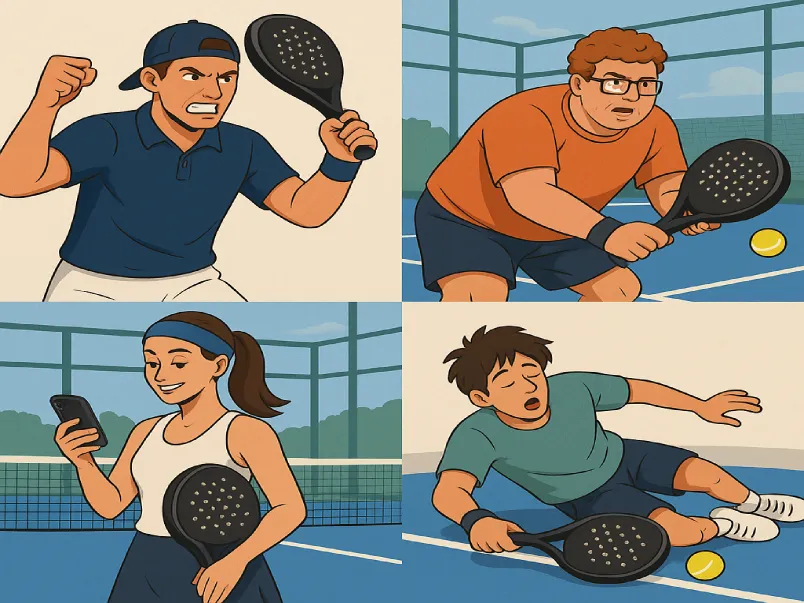
Stereotype 1: The Aggressive “Bajada” Basher
Tagline: All power, no patience.
Signature Move: The smash (or any shot they can hit at 100% power).
On-Court Vibe: The “Bajada Basher” is intense. They’re constantly hunting for the winner, grunting as they deliver crushing shots. Their mindset is simple: “Hit hard, hit fast.”
Mantra: “Why play a soft shot when you can hit it through the fence?”
Strengths: Their power is undeniable. They’re often the driving force of the team, forcing the opposition to react quickly and often making mistakes.
Weaknesses: Unforced errors are a big problem. This player can be so fixated on smashing the ball that they forget to play the long game. Their defense is usually weak, and they can easily become a “ball hog”—too focused on their own shots.
You’ll Know You’re This Player If… you’ve broken a padel racket out of frustration.
The aggressive “Bajada” Basher can be a force to reckon with. But beware—too much focus on power and you might just end up losing more points than you win.
Stereotype 2: The Tactical Professor
Tagline: The human chess master of padel.
Signature Move: The perfect lob or a deceptive “chiquita” (soft drop shot).
On-Court Vibe: Calm and collected, this player is thinking two or three shots ahead at all times. Their focus is on placement and strategy, not brute force.
Mantra: “Angle and placement over power, every time.”
Strengths: Consistency is key for the Tactical Professor. They’re excellent at setting up their partner for easy points and always know the best angles for every shot.
Weaknesses: They can sometimes overthink the game, leading to missed opportunities. Their lack of killer instinct means they often struggle to close out points.
You’ll Know You’re This Player If… you diagram plays in your head during the warm-up.
The Tactical Professor is a master of patience and planning. While they might not win every point with a smash, they certainly know how to control the game.
Stereotype 3: The Social Butterfly
Tagline: Here for the vibes, the score is secondary.
Signature Move: The friendly “sorry!” after a mistake.
On-Court Vibe: This player is all about the social experience. They’re more focused on chatting and having fun than winning the match. While they might make an occasional great shot, their heart is in the conversation.
Mantra: “Good shot! Now, did I tell you what happened to me yesterday?”
Strengths: The Social Butterfly brings an easygoing energy to the court. Their positivity can help reduce stress and keep everyone relaxed.
Weaknesses: This lack of focus can often lead to missed shots and mistakes. Their lack of concentration can be frustrating for a partner who’s trying to win.
You’ll Know You’re This Player If… you’ve suggested getting a drink during the match.
If you’re playing with a Social Butterfly, you’re likely in for a more laid-back experience. They’ll always be the one making everyone laugh—even if it costs you a few points.
Stereotype 4: The Wall
Tagline: The unbreakable defender.
Signature Move: The impossible get. They seem to return everything, no matter how hard it’s hit.
On-Court Vibe: Silent, focused, and relentless. The Wall is tireless, and they seem to cover every inch of the court.
Mantra: “You can hit it, I’ll get it back.”
Strengths: Excellent at making opponents work for every point. They force errors by being an immovable presence in the backcourt.
Weaknesses: The Wall can be too passive, relying heavily on defense without ever taking the initiative to finish a point.
You’ll Know You’re This Player If… your opponents look exhausted and you’re not even sweating.
This defensive machine will tire out opponents with their persistence. But be warned—they’ll rarely take control of the match themselves.
Stereotype 5: The Glass Cannon
Tagline: Brilliant but brittle.
Signature Move: A stunning, world-class winner… followed by a shocking miss.
On-Court Vibe: The Glass Cannon is an emotional rollercoaster. One moment they hit a winner that leaves everyone speechless, the next, they hit the net on a simple shot.
Mantra: “I’m either on fire or I’m a disaster. There is no in-between.”
Strengths: When they’re on, the Glass Cannon can win matches single-handedly. Their raw talent shines through, and they can be impossible to stop when confident.
Weaknesses: Inconsistent at best, mentally fragile at worst. This player is either brilliant or a liability, and you never know which one will show up.
You’ll Know You’re This Player If… your partner never knows what to expect from you.
The Glass Cannon’s highs are incredible, but their lows can be equally as frustrating. When they’re on, they’re unstoppable—but when they’re off, it’s painful to watch.
Stereotype 6: The Apologizer
Tagline: Sorry, not sorry… actually, just sorry.
Signature Move: Apologizing for every mistake, even the unavoidable ones.
On-Court Vibe: Overly polite and constantly apologizing. The Apologizer is desperately seeking approval from their partner and is often insecure about their performance.
Mantra: “Sorry! My fault! Oh, you missed? Sorry, that was my bad too!”
Strengths: The Apologizer is an easygoing teammate. They’re non-confrontational and always willing to support their partner.
Weaknesses: The constant apologies can be distracting and deflate the team’s morale. Their insecurity can also create unnecessary pressure on their partner.
You’ll Know You’re This Player If… you’ve apologized to the net after the ball clipped it.
The Apologizer is the ultimate team player in terms of personality, but their constant need for reassurance can get on the nerves of their more confident teammates.
Stereotype 7: The Veteran with All the Gear (and No Idea?)
Tagline: Looks like a pro, plays like… well.
Signature Move: Adjusting their brand-new, expensive watch between points.
On-Court Vibe: Confidence is key for this player, especially when it comes to their appearance. But unfortunately, their game doesn’t quite match their equipment.
Mantra: “It’s not the player, it’s the equipment. And my equipment is the best.”
Strengths: They likely know a lot about the sport’s history and equipment. A great source of stories for anyone who wants to learn about the evolution of padel.
Weaknesses: Style over substance. Their focus is more on their kit than their skills, and they’re often overly critical of others’ gear.
You’ll Know You’re This Player If… you spent more on your padel bag than on your first car.
If you’re playing with the Veteran, you might get some great advice on how to improve your game—though it might be hard to take seriously if they’re struggling to execute basic shots.
Stereotype 8: The Glass-Half-Full Cheerleader
Tagline: The team’s motivational speaker.
Signature Move: The enthusiastic high-five and “We’ll get the next one!”
On-Court Vibe: Perpetually positive and encouraging, this player refuses to give up, no matter the score. They never let the team feel defeated.
Mantra: “No worries, great effort! Let’s go!”
Strengths: Their positivity can be contagious and helps keep the team spirit high. Even when the score is going against them, they’re still ready to rally.
Weaknesses: Sometimes their optimism can seem misplaced, especially after a tough loss. When things aren’t going well, they might push too hard for a silver lining.
You’ll Know You’re This Player If… you’ve genuinely enjoyed a match you lost 6-0, 6-0.
The Glass-Half-Full Cheerleader is the kind of teammate you want in your corner, especially when you’re facing tough opponents. But sometimes, it’s okay to just acknowledge the loss.
III. Conclusion: The Perfect Padel Cocktail
One of the best things about padel is the wide variety of personalities that come together on the court. Whether you’re the power hitter, the strategist, or the social butterfly, each type brings something unique to the game. These player types create a dynamic and fun atmosphere, ensuring that no two matches are ever the same.
Of course, the best teams are made up of complementary personalities. Pairing the Aggressive “Bajada” Basher with The Wall creates a dynamic of offense and defense that’s tough to beat. The Tactical Professor and the Cheerleader make for an excellent combo, with one setting up the points and the other keeping morale high.
So, which stereotype are you? Maybe you’re a hybrid—part aggressive, part strategic, part social. Whatever the case, embrace your padel persona and respect others’ playing styles. At the end of the day, we all share the same love for the game.
FAQs for “Padel Player Stereotypes: Which One Are You on the Court?”
- What are padel player stereotypes?
Padel player stereotypes refer to the various personalities and playing styles that you typically encounter on the court. These include aggressive players, strategic thinkers, social players, and more. Each stereotype has its own unique characteristics, signature moves, strengths, and weaknesses. - Which padel player stereotype is the most effective on the court?
Each player stereotype brings something valuable to the game. The effectiveness of a player depends on the dynamics of the team. For instance, combining an aggressive “Bajada Basher” with a defensive “Wall” can create a powerful team dynamic. It’s all about complementing strengths and minimizing weaknesses. - Can a player fit into multiple stereotypes?
Yes! Many players exhibit traits from multiple stereotypes. For example, a player might have the aggressive nature of a “Bajada Basher” but also have the tactical mind of a “Professor.” It’s not uncommon for players to blend different playing styles. - How do I know which padel stereotype I am?
Pay attention to your approach during games. Are you always going for the big shot, or are you thinking about placement and angles? Do you focus on socializing or winning? Answering these questions will help you identify your padel stereotype. - How can I improve my padel game based on my stereotype?
Understanding your padel stereotype can help you enhance your game. For example, if you’re a “Glass Cannon,” focusing on mental resilience and consistency might be beneficial. If you’re a “Social Butterfly,” working on concentration and shot execution will improve your game.